Blog · Prioritizing · Leer en español · Ler em português
Fifteen priorities aren't priorities: the quadrant organizes the conversation, you make the decision
An effort versus potential matrix organizes the conversation, but it doesn't decide. When the quadrant is enough and when you need a budget or pairwise duels.

Every list of priorities I've seen in a committee has the same flaw: it has fifteen “number ones.” Nobody says it like that, of course, but when you ask which of the fifteen they'd do if there were only money for one, the room goes quiet, and in that silence you can see there are no priorities, just a wish list sorted by who proposed it. Prioritizing is deciding what you're not going to do, and that's exactly what a long list lets you avoid.
Let me tell you about a recent case, which wasn't in a committee but in something more interesting. I've been helping build an external network of health professionals, specialists in the same field, who wanted to create the network and find sustainability opportunities so it wouldn't depend on anyone's goodwill. They had tons of ideas, and they all sounded good (that's what happens when the people proposing them know their subject well). The problem wasn't a lack of options; it was too many.
What we did was the most classic thing there is, a two-axis quadrant: on one axis we measured how much effort it would take to get each idea off the ground, and on the other how much potential it had to generate sustainability for the network. The ideas ended up plotted across the four quadrants, and the conversation changed immediately, because we were no longer arguing about whether an idea was good (they all were) but about where it had landed and why.
Now, the important part, which is what almost always gets misunderstood about this tool. Having the ideas plotted on the quadrant doesn't make the decision. It only guides the conversation so that later, together, people decide with some criteria; the quadrant says “these four are in the top right,” but it doesn't say which of those four goes first, or whether one of the ones in the bottom left deserves to be done anyway because it's the one the person who'll sustain the network cares about. In the network's case it worked very well, and the network was built afterward based on what was decided that day.
I'll grant that there are cases where the quadrant isn't enough, and the most common is when all fifteen ideas land in the top right (and it happens, because everyone rates their own with affection), at which point the picture no longer helps you give anything up. For those cases there are two tools that force you to really give things up, and I like them precisely because they're uncomfortable.
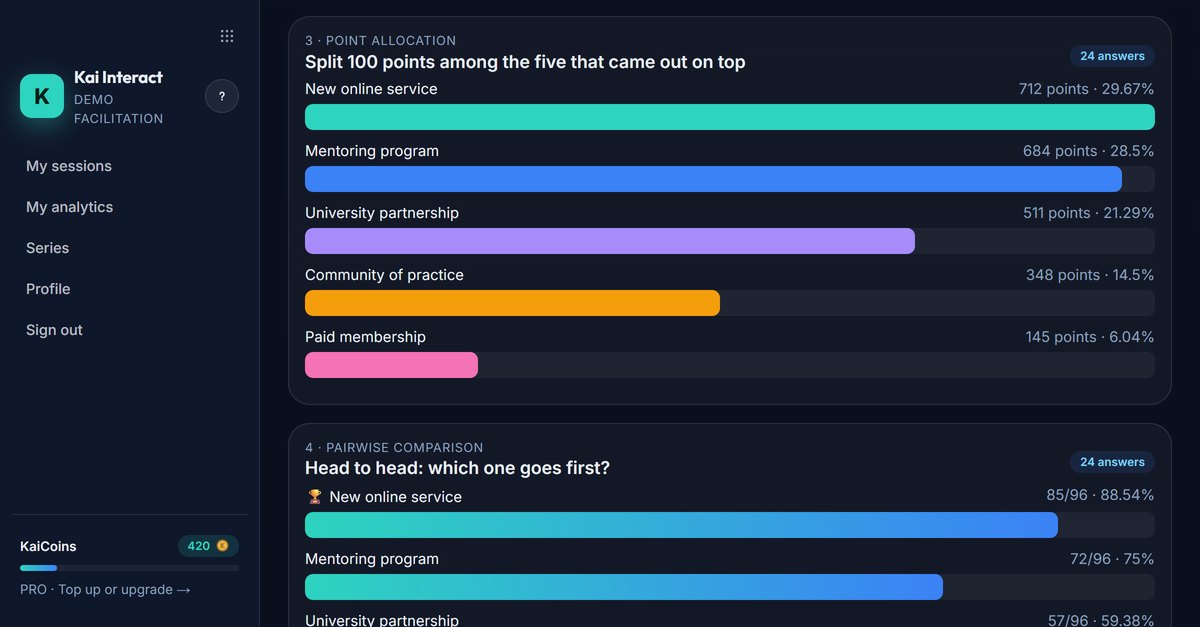
The first is handing out a budget. Each person gets a hundred points (or a hundred million in play money, if it's a finance crowd) and splits them among the options however they want; what nobody can do is give a hundred to everything. In a normal vote you vote for what you like, and with a budget you have to decide what you like less, which is exactly the question the long list hides.
The second is pairwise duels. Instead of ranking fifteen things at once (which nobody does well; the brain can't handle it), you compare them two at a time: this one or this one? With enough duels you get an order that's much more honest than any ranking, because nobody can put everything tied for first place. Let's think about the scale: with fifteen options there are a hundred and five possible pairs, so you don't compare them all, you compare enough for the order to settle.
All three (the quadrant, the budget and the duels) are in Kai Interact, which I built myself, so take it with that bias. All three are activities on the Free plan, and what helps me most is being able to chain them: first the quadrant to see the map, then the budget or the duels with only the ones that ended up on top, and at the end an agreement with an owner for each of the ones that survived.
I'm left with a doubt, and I mean it. How many priorities really fit in an organization's year? I suspect far fewer than we write down, but I don't have a number I can defend. How many do you work with?
See you next time. Mauro Z.