Blog · Prioritizing · Leer en español · Ler em português
From brainstorming to a 2x2 matrix without stopping the workshop (or how I stopped copying ideas by hand between two screens)
Ideas always come. The hard part is the next ten minutes, when sixty sticky notes have to become five options to rate without stopping the workshop.

Some people show up to their first workshop afraid that not enough ideas will come out. You and I know that's a rookie fear, because ideas always come (and if the group is fired up, they come in spades). The real fear, the one you only learn after many workshops, is what happens in the next ten minutes: sixty sticky notes have to turn into five things someone is going to rate, and in that stretch the facilitator stops facilitating and starts working as a secretary.
Let me tell you how it happened the last time, because it was recorded. In a live workshop on business models (we called it “Explora lo imposible,” roughly “explore the impossible,” which is far too ambitious a name for a session about burger joints) we had about twenty-five people moving sticky notes around a Miro board, each one adding the attributes they thought mattered in that industry. Pure divergence: “if you see someone already put it up, it doesn't matter, put it up anyway.” Then I asked the board's AI to group them, and it gave us seven reasonable groups (with one left all by itself, “Instagram-worthy,” which I moved by hand, because the point is not to blindly accept whatever you're handed). We voted with three votes each and kept five. Up to that point, a nice exercise.
And then I said the line: “to rate these attributes, we're going back into Mentimeter.” Someone asked in the chat how I had moved the attributes from Miro to Mentimeter, and the honest answer was by hand, with both screens open, because there were only five so it wasn't that hard, and because I already had the template ready and only changed the titles. That's true. It's also true that, while I was copying, twenty-five people were staring at a frozen screen.
Maybe you think I'm exaggerating over two minutes. A good facilitator uses those gaps (“go grab a coffee while you're at it”), and the group survives. I agree, and in fact I did it that way for years in in-person workshops, where the analog version of the problem is worse: the wall full of sticky notes, the “give me a moment while I organize this,” and a break that eats a quarter of the day. But I think the problem isn't the break. The problem is that divergence and convergence live in different tools, and between the two there's a human copying, who on top of that is the only person in the room who should be thinking about the group and not the keyboard.
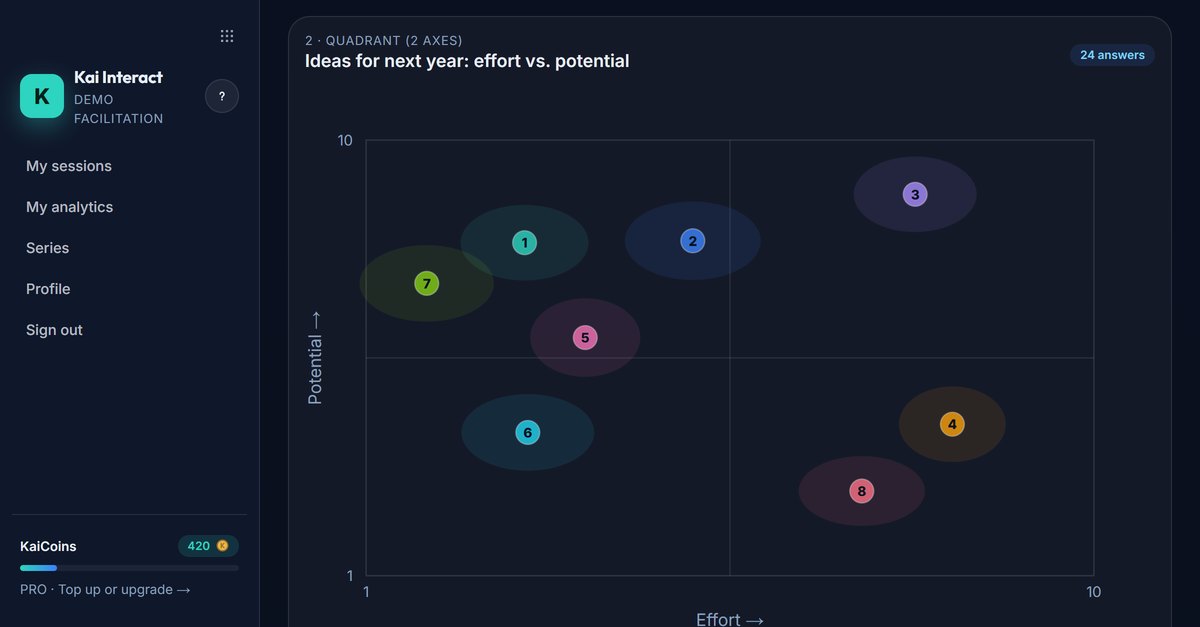
Not long ago the opposite happened to me, and that's why I'm writing this. In an innovation training, I asked the usual open question (“what ideas do you have for…?”), the tool itself used AI to consolidate the answers into a handful of ideas, and instead of copying them anywhere I asked Claude, connected to the session through the tool's API, to read those consolidated ideas and create the next activity: a quadrant with the ideas already loaded, ready for the group to rate on two axes. It did it in the time it took me to say it out loud. Nobody went for coffee, the conversation didn't cool down and I didn't touch a single cell. For me it was a home run, and I say it with the caution of someone who has spent years copying by hand.
Okay, I'm drifting into tech here, and this article isn't about APIs (although, for the curious, the only unusual thing I did was give Claude a key to the session; the rest was asking for it in plain Spanish). What matters to me is what changes in the workshop when convergence is built on the spot, and I think it's two things.
The first is that the quadrant uses the group's words, not mine. When I build the activity the night before, however well I know the team, the options people rate are the ones I imagined would come up. When it's built from what they just wrote, what they're rating is theirs, ugly wording and all, and that changes how much they believe the result.
The second is that AI grouping has to be corrected in front of everyone. I learned this in Miro and I keep doing it in any tool: the machine proposes seven groups, you move two sticky notes, rename one of the groups, and the room sees that the synthesis didn't come from an algorithm but from them. It's a minute of work that's worth more than the grouping itself (and it also keeps anyone from saying “well, the AI put it there,” which is the new version of “well, that's what the consultant said”).
In case it helps as a reference, the scale of what we're talking about: in that workshop it was twenty-five people, seven groups, three votes per person, two minutes of copying by hand. A normal-sized workshop. If what you're running is an exercise with forty or sixty people and four rounds of convergence, those two minutes become half an hour, and half an hour of a room with forty people is twenty hours of work (more than two full days of someone's time), spent watching the facilitator copy.
The tool I used for the second version is Kai Interact, which I built myself with AI to solve exactly this (so take it with that bias). The open question, the AI grouping and the quadrant are on the Free plan; the API is what let me chain them together without touching anything. It's not the only way to do it, and I genuinely want to know how you handle it: how do you get from ideas to a decision in your workshops? Does anyone else copy by hand between two screens, or am I the only one admitting it?
See you next time. Mauro Z.
P.S. If you want the technical details of how Claude connects to a session, I'll write them up separately. It's not long, but here it would have sent me down another rabbit hole.