Blog · Large groups · Leer en español · Ler em português
Live polls with QR codes: what I learned in front of 350 people (and almost all of it from what went wrong)
What changes when 350 people answer from their phones, and the failures that repeat: the QR code nobody can scan, the basement with no signal, the latecomer.

Talking to three hundred and fifty people sitting in an auditorium is a one-way conversation, however many times you ask “how are we doing?” and someone in the third row nods. In the large conferences I've given, what changed that was getting people to answer from their phones. Not because the poll results were very deep (they almost never are at a conference), but because for the first time I felt I was communicating with the audience and not just standing in front of it.
Here's what that looks like from the stage. At one of those conferences, with about three hundred and fifty people in person, I launched the questions and the answers started arriving on the screen live. That let me make a few jokes about what was coming in (an audience laughs much more at itself than at the jokes you bring prepared), but also reach some conclusions with them, in full view of everyone. Without that screen, what I'd have had was my impression of the room, which with three hundred and fifty people is basically the impression of the first five rows.
Now the honest part. It's the one that teaches the most. There were failures, and the failures repeat at almost every conference (the auditorium changes, not the failure), so it's worth telling them in some detail so nobody discovers them live the way I did. Some people don't know how to scan a QR code, or their camera is full of other stuff and it won't open. I once got an auditorium in a basement where the connection was terrible. And there's always someone who drops out halfway (because they answered a message, because they closed the tab by accident, because they arrived late) and then wants to get back in, right when I'm already on the fourth question and the QR code was on the first slide.
Some of you might think that's asking too much of a conference, and that the sensible thing is to just give the talk. I get it, and there are talks where I wouldn't put in a single question, because if the topic doesn't need the audience, interrupting them to vote is pure decoration. But when it does need them, the cost of failure is measured in people. If ten percent of three hundred and fifty are left out, that's thirty-five people, which is a whole classroom watching everyone else take part.
So you pick up little tricks. None of them is sophisticated. The first is having a plan B for people who can't manage the QR code: a short code they can type by hand and a web address you can read out loud. The second, and for me the most important, is that the QR code is always visible, not just at the start; people get disconnected by mistake, step out to do something else or arrive late, and whoever wants to join halfway through has to be able to connect without asking you to go back to that slide. The third is assuming the venue's connection will be worse than the organizer said, and testing it from the last seat before you start (from the stage it always works).
There's one more thing I learned, and it's about size. With twelve people you can ask out loud and listen to each one (and you should; the tool is almost always overkill there), but with three hundred and fifty you can't, and that's where the poll stops being a game and becomes the only way to know what the room thinks, so the questions have to be short, the kind you answer in ten seconds with your thumb, and the result has to look big on the screen. A question with five paragraphs of context, in front of an auditorium, is a question nobody answers.
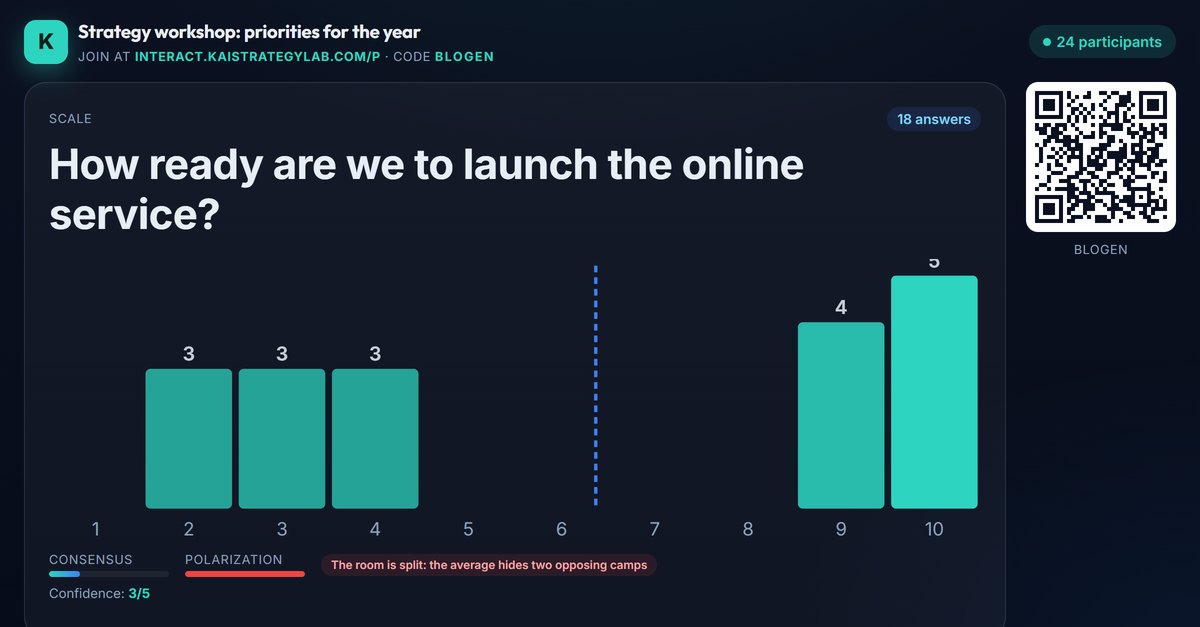
I solved the always-visible QR code in the tool I built, Kai Interact (take it with the bias of the person who made it): the projected screen shows the QR code and the code at all times, no matter which activity we're on, and whoever drops out and comes back gets in with the same code to whichever activity is open. It's a silly little design detail, but it's the one that has brought the most people back into the conversation.
I'm left with the opposite question, and I haven't figured it out. Where's the line at which a poll starts getting in the way at a conference? I think it's when you ask to show off the tool and not to listen to people, but I'm not sure I always see it in time. How do you notice it?
See you next time. Mauro Z.