Blog · Large groups · Leer en español · Ler em português
Hybrid workshop: how to get the YouTube crowd building too (and keep the people in the room from getting all the attention)
A hybrid workshop has two rooms, even if the invitation says one. What I learned so the people joining remotely build too, instead of just watching.

A hybrid workshop almost always has two rooms, even if the invitation says one. There's the room of the people who are there (sitting in the venue or with their camera on in Teams), who talk, ask questions and get the facilitator's attention, and there's the room of the people watching, who at best type something in the chat and at worst left twenty minutes ago without anyone noticing. The technology gets solved with a good cable and a sound check. What doesn't solve itself is getting the second room to build too.
Before going on, a distinction it took me a while to see. There are two different kinds of hybrid, and they're facilitated differently: the one with some people in the room and others connected, and the one that's virtual end to end but with people spread across platforms that don't talk to each other (some in Teams, others on YouTube). The first is an attention problem (the facilitator's, mostly). The second is a design problem, because there are things one platform lets you do and the other doesn't.
The second one happened to me in a live workshop on business models, one of the ones we did for Innovation Week (with the fan on, because it was one of those sweltering days). I spent the weekend before thinking about how to run a workshop knowing that a few people would be connected through Teams and most of them would be watching on YouTube, because if you say it's a workshop and not a talk, you have to force yourself to make it a workshop. When we got to the part about breaking the boundaries of the industry, I split the thirty people on Teams into six breakout rooms of four or five, each with its own board and its own path, and that's when what I already knew would happen showed up: the YouTube people don't have breakout rooms.
Since I knew it, I prepared for it. The people in the breakout rooms had their task, and with the ones who stayed on the stream I went through the six paths for breaking the industry's boundaries one by one, with an exercise I had put together for them beforehand, so they could see what mattered in what the others were doing. Did they build the same thing as the people in the rooms? No, and I'm not going to pretend they did. But they didn't spend half an hour staring at a “we'll be right back” sign either, which is what happens when you design the workshop only for the platform that has breakout rooms.
The first kind of hybrid, room plus remote, taught me something else, and it taught me by surprise. At a conference I had about a hundred and twenty people in the room, and when I launched the first exercise with the tool there were two hundred and fifty connected. That's when I realized how many people were following me from outside (more than half, doing the math), and that I had prepared the talk looking only at the hundred and twenty in front of me. The exercise went very well, so this doesn't sound like a tragedy. But looking back, I was left with a question I didn't ask: if I had marked at the start who was in the room and who was connected, I could have seen whether the two groups answered differently, and in a strategy or innovation workshop that difference is often exactly the conversation that needs to happen.
I'll concede what needs conceding. The problem with hybrid isn't the tool, it's the facilitator, and I include myself. The person who's present gets more follow-up, more participation and more importance than the one who's connected, almost without meaning to, because the one who's present looks you in the eye and the connected one is a black box with a name. That happens a lot, and it isn't fixed with software; it's fixed by deciding, before you start, that the room of people watching gets its turn too.
What I do today, after several of these, fits into three decisions. The first is that when the platform doesn't let me do the same thing with everyone, I design two tasks, not one task and a gap. The second is that in breakout groups I put the virtual people with the virtual people and the in-person people with the in-person people, because mixing them, in my experience, doesn't work as well (a table with four people in chairs and one on a speaker ends up being a table of four). The third is that individual participation goes through a channel where everyone counts the same, and that channel is the phone: when the question is answered from the phone, the person in the room and the person on the stream have exactly one vote each, and nobody wins by being closer to the microphone.
Let's think about the scale of what's lost if you don't do it (and I'm not talking about technology). If at that conference I had only listened to the room, I would have been facilitating for less than half of the people who were taking part, and I wouldn't have found out (the silence of someone connected looks far too much like the silence of someone connected who agrees).
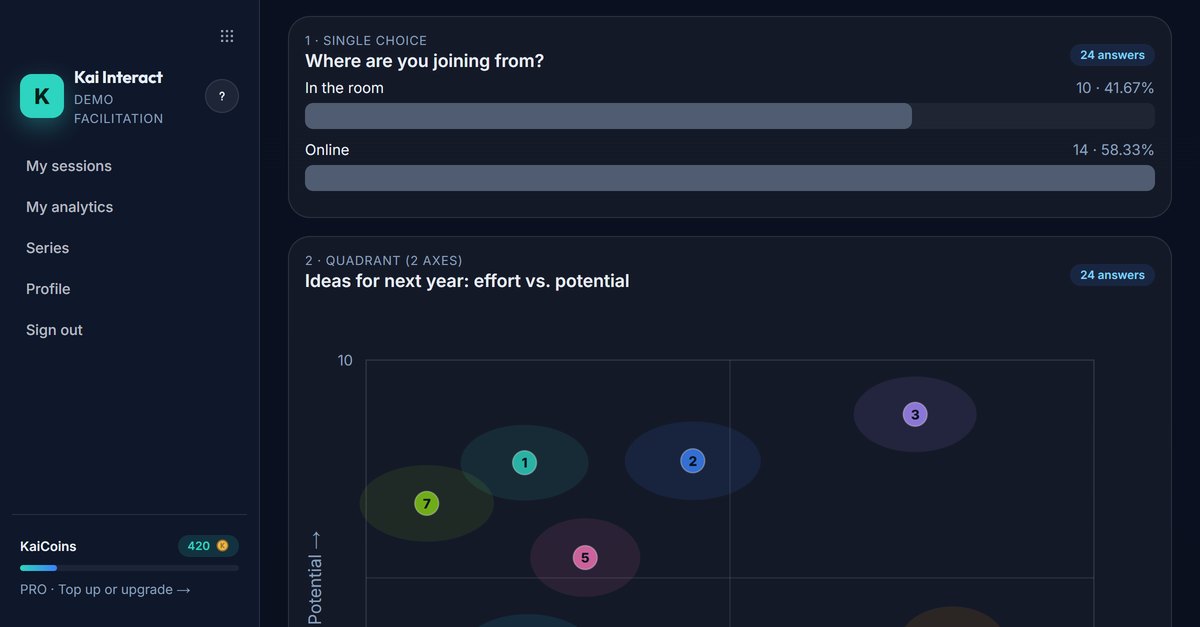
For that third part I built Kai Interact, so read it with that bias. People join with a QR code or a code from any browser, whether they're in the room or watching the stream, and a first question like “are you here or online?” can be marked as a segment, so every result in the session splits in two and the tool warns you if the two groups answer differently. It's exactly the question I was missing at the conference of the two hundred and fifty.
I still have a doubt I haven't resolved. Separating the virtual people from the in-person ones at the tables works for me, but sometimes I feel it looks too much like giving up, as if I accepted that they'll never talk to each other. Do you mix them or separate them? And has a truly mixed table ever worked for anyone?
See you next time. Mauro Z.