Blog · Closing the workshop · Leer en español · Ler em português
The workshop report on the same day: what it has to cite for people to believe it
A report written from memory can't be checked. What it has to cite so that people who weren't there believe it: the activity, the number and the owner.

A workshop report is usually written the next day, from the facilitator's memory, and that's why it looks so much like the photo of the wall. You sit down with a coffee (or two, if the workshop was long), open a blank document, look at the loose notes and the photo, and write what you think happened. What comes out is reasonable, well written, and has one problem: nobody who wasn't in the room has any way of knowing whether it's true.
Let's think about who reads that report. Not the people who were there (they have their own version, and everyone remembers the wall that suits them). It's read by the boss who couldn't make it, the department that has to execute, the committee that has to approve the budget, and for them the report is the only evidence that the workshop decided anything. If it says “the group prioritized the customer experience,” the obvious question is: why? How many? Compared to what? And a report written from memory almost never answers it.
Some time ago I did an exercise that changed how I think about this, although it wasn't from a workshop (it was a survey on organizational culture). I had ten files with the answers to a survey and asked a deep research AI to analyze them, with an explicit instruction: don't search the internet, answer only with these ten files. I asked for a structure (summary, analysis by question, cross-cutting analysis, prioritized gaps, action plan and a final table), and eleven minutes later it handed me the report with ten citations and zero searches, each claim tied to the file it came from.
What I liked most wasn't the speed, although eleven minutes for that is outrageous (by hand, I'd rather not do the math). It was being able to see where it was getting each thing from: for every question it gave me the synthesis, the common ground, the differences, and which file each one came from. That turns a text you have to believe into a text you can check, and the difference between the two is the difference between a report that gets filed and one that gets used.
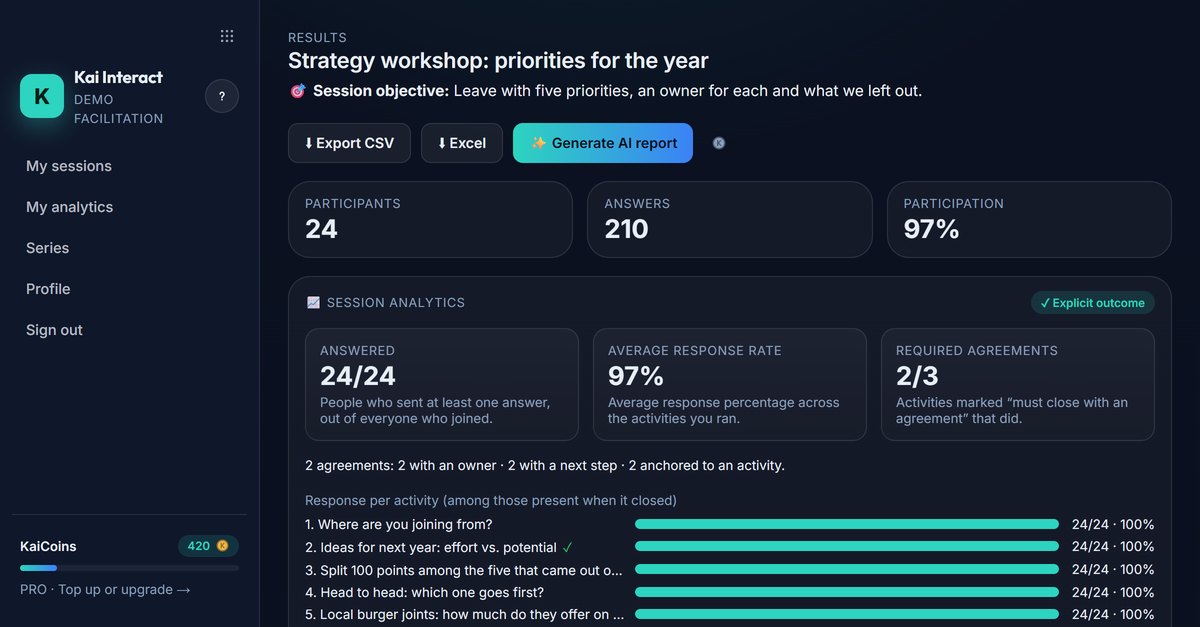
That's where I got what I think a workshop report has to cite for people to believe it. First, each conclusion with the activity that produced it, so it's clear whether it came from a vote, a conversation or the facilitator's head. Second, the number with its scale: not “most preferred,” but “nineteen out of twenty-six,” and if the group was divided, say so, because an average of seven with half at four and the other half at ten isn't the same as a calm seven. Third, the agreements with their owner and their next step, and what was decided not to do.
I'll grant that this carries a risk, and not a small one. A report made with AI in minutes can contain an odd interpretation, a sentence the source didn't say or a conclusion that's a little too neat, and the faster it arrives, the more tempting it is to send it without reading it. That's why I insist on citations: they're not an academic ornament, they're what lets the facilitator review in ten minutes what the machine wrote in one, and fix it before it goes out.
And one more thing about the “same day.” A report that arrives a week later arrives when the group is back in its routine and the workshop's energy is spent; one that arrives that same afternoon arrives while people still remember why they voted the way they did, and they can correct it if something doesn't add up. It's the difference between meeting minutes and a working tool.
That's why, in the tool I built, Kai Interact (and here's my declared bias), the report is generated with AI when the session ends, but each conclusion cites the activity and the numbers that support it, and the agreements come out anchored to that evidence. And even so you have to read it before sending it, because it's one thing for the tool to cite and another for you to agree with how it interpreted things.
How long does it take you to send a workshop report, and who actually reads it? I suspect the second answer is more uncomfortable than the first.
See you next time. Mauro Z.