Blog · Closing the workshop · Leer en español · Ler em português
Why a workshop ends in a photo of sticky notes (and what it should end in)
My first workshops ended in a photo of the wall. What I learned to leave in its place: agreements with owners, the evidence for each one and what we didn't choose.
My first workshops all ended the same way, and there were a lot of them, so I say this from experience: someone pulled out their phone and took a picture of the wall. The photo landed in the WhatsApp group that same night with a “great day, team,” and by Monday nobody, me included, could say what had been decided. I tell this with affection, and with some embarrassment, because for a good while I measured my workshops by the energy in the room, and the energy is real. But energy is not a result.
The case I remember best is the business model workshops. The classic format was a four-hour session in which, with luck, you filled in a third of the Canvas. Then you had to meet two or three more times, with homework between sessions (“go find out what the customers think of it, and bring it back”), and lowballing it, that was twelve hours of work for an entire group, plus whatever each person did on their own. Twelve hours of ten people is a hundred and twenty person-hours (if the group is bigger, do the math, it's scary), in other words three full weeks of someone's work invested in a wall that in the end got photographed and forgotten.
Before going on, what's good about the wall, because there's plenty. The sticky note forces you to write short, you move it with your hand, and a wall full of them says “something happened here” in a way no screen can match. I still use them, paper and digital (the digital ones lose the charm of peeling off the wall on their own mid-afternoon, but in exchange they let you group them), and I don't think we should drop them. The problem isn't the sticky note. The problem is that the sticky note records participation and not the decision, and I confused the two because the first one is visible and the second one isn't.
What came next was a long list of patches, all by hand. In some workshops I closed by reading out loud what we had decided, and people nodded, and on Monday each of them remembered something different. In others I closed by handing out tasks, and the tasks got done, but nobody knew which decision they came from. In others I got into the habit of writing down what we had left out, and that was what made people most uncomfortable and what helped the most. Then I started inventing formats (an agreements template, a column on the board for what we didn't choose, a sheet I sent out the next day), and each format fixed one part and left another hanging.
From all those patches I drew a conclusion that today I defend with quite a lot of conviction: at the end of a workshop, three things have to remain, and none of them is the executive summary that goes out the next day (that's almost always the photo, only in prose).
The first is agreements with an owner. Not “improve communication with customers” but “Daniela checks with the three big customers whether the problem is delivery time, before the 15th.” An agreement with no one answering for it and no next step is a wish, and wishes photograph very well.
The second is the evidence behind each agreement. Why did we decide this? Because it came first in the vote with twelve votes, because on the one-to-ten scale the group gave it eight and a half, because it landed in the top right of the quadrant. When the agreement carries the activity and the number that produced it right next to it, whoever wasn't in the room can believe it, and whoever was can't rewrite it on Monday (which is what usually happens with photos: everyone remembers the wall that suits them).
The third (and this is the one that almost never shows up in any photo) is what we didn't choose. To decide is to give something up, and a workshop that picks five priorities without writing down which fifteen others were left out didn't decide anything; it just made a shorter list. In strategy we know this by heart (“being different means giving things up,” we've said it a thousand times), and still, in the workshop, we're embarrassed to write down what we gave up, because writing down that someone's idea didn't make it feels aggressive. But it's exactly the other way around: what's aggressive is for the idea to vanish from the photo without anyone saying so.
Some of you may be thinking this is a matter of facilitator discipline, and you're partly right. A good note-taker, half an hour at the end to close agreements, and an email the next day solve a lot. That's how I did it for years, and it worked until the workshop grew: with forty people and six activities, the note-taker can't keep up, the closing gets cut short because someone has to leave, and the next day's email gets written by the facilitator from memory, which by then is just one more wall.
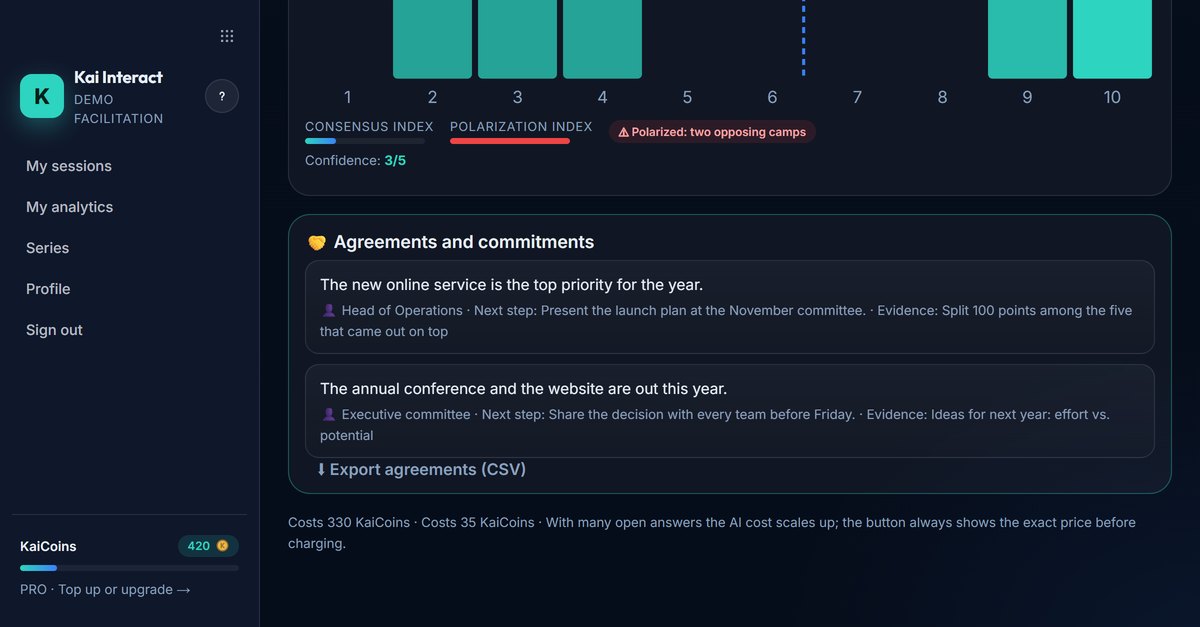
Kai Interact is, in large part, the grown-up version of those patches, and I built it myself (so take it with that bias). It's a live session tool where people take part from their phone through a QR code, and what I used to do by hand in every workshop it now asks for: each activity can require an agreement before it closes, the agreement carries an owner and a next step, and it stays anchored to the activity and to the numbers that produced it. The report comes out when the session ends and cites that evidence, instead of summarizing my impression of the day. It's not magic (in fact it forces something uncomfortable, which is closing each activity by saying out loud what we decided and who's responsible), but it's what I learned workshop by workshop, put in one place.
I'd like to know how you do it. What's left of your workshops a month later? And has anyone tried writing down what was given up in front of the group, or am I still the only one who finds it awkward?
See you next time. Mauro Z.