Blog · Tools · Leer en español · Ler em português
From open question to decision: grouping ideas with AI without trusting it blindly
AI groups in seconds what used to take a good while at the wall. What it does well, what it can't decide and why it pays to correct it in front of the group.

The open question is the best question in a workshop and the worst one to process. It's the best because people say what they think in their own words, without you putting the options in their mouths. It's the worst because forty people answering at once produce forty answers, many of them repeated in different words, and someone has to turn that into five themes before the group loses the thread.
For years that someone was me, with a wall, a ton of sticky notes and the famous “give me a moment while I organize this.” Doing the affinity mapping by hand has something good about it (you read every contribution, and that gives you a very fine sense of what the room thinks), but in a four-hour workshop it's a pause that eats a good chunk of the day, and while you're grouping, the group cools off. That's why, when tools started grouping with AI, it struck me as some of the best news for those of us who facilitate.
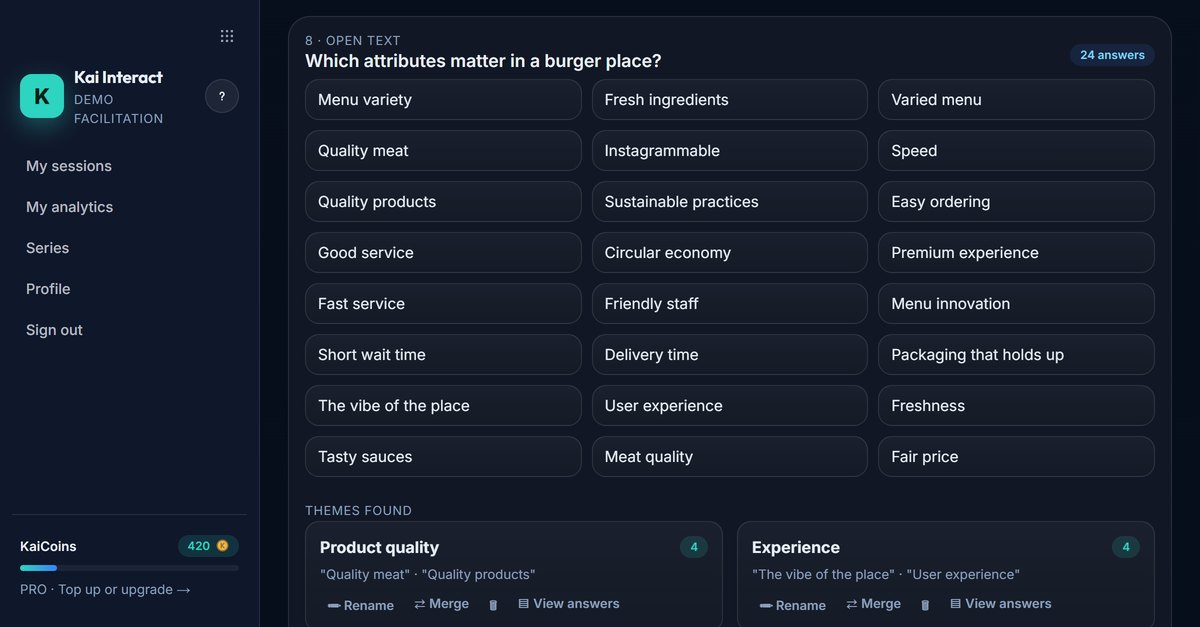
Let me tell you what that looks like in practice, with an example that was recorded. In a live workshop on business models, twenty-five people put the attributes they thought mattered for burger joints on a board, and I asked the board's AI to group them by keyword. In seconds it proposed seven groups: product quality (there were five sticky notes about the meat, about quality, about quality products), customer service, experience, variety and freshness, speed and efficiency (with the same “time” repeated four times), sustainable practices, and one that was left all by itself and said “Instagram-worthy.”
What the machine did well is what it always does well. Putting together what's said in similar ways. What it couldn't do is what matters. Is “Instagram-worthy” a separate group, or part of the experience? For me it was experience, and I moved it by hand in front of everyone; I also felt like moving a sticky note to variety and freshness, and renaming a group. None of those decisions is technical. They're all about judgment, and judgment is what the group comes to a workshop to bring.
From there comes the rule I repeat every time someone asks me about this: don't blindly accept what you're handed. AI grouping is a draft, and a very good one, but if it's projected as the final result two bad things happen. The first is that you lose nuances the machine doesn't see (the odd sticky note that's the best idea of the afternoon is usually exactly the one left on its own). The second is subtler: the group stops feeling the synthesis is theirs, and starts saying “well, the AI put it there,” which is the new version of “well, that's what the consultant said.”
I'll grant that correcting in front of everyone takes time, and that the whole point of AI was to save it. But do the math: grouping forty contributions by hand easily took me ten or fifteen minutes of pause, and reviewing the machine's proposal with the group watching takes two or three, with the advantage that those two or three minutes are participation and not waiting. It's the best time trade I know of in facilitation.
There's a line I said in a video about analysis with AI and I stand by it: this is gold, but let's not be blinded by it. You have to review, you have to understand, you have to check whether the source really said what the machine says it said. We always have to keep a human in the loop, and not out of romanticism, but because it's the human who later has to defend the decision.
In Kai Interact, the tool I built (with the bias that implies), AI grouping works this way on purpose: the AI proposes the themes during the session, and the facilitator can rename them, merge them, move cards from one theme to another or send something to “Others,” while seeing the real answers behind each group. And you can regroup when more answers come in, because the room doesn't stop thinking when you decide to group.
Do you correct the grouping in front of the group or beforehand, in private? I do it in front, but I admit there are groups (very hierarchical ones, especially) where correcting in public can be read as the facilitator being the one in charge.
See you next time. Mauro Z.