Blog · Large groups · Leer en español · Ler em português
Office Christmas trivia: forty questions with answers, and how to run it live
Forty Christmas trivia questions with answers, in four rounds plus a tie-breaker, and how to run it live in twenty minutes, whether you are 15 people or 150.

Office Christmas trivia works with twenty questions, twenty minutes and one rule: everyone answers at the same time from their phone, instead of the win going to whoever shouts first. Here are forty questions with answers, in four rounds plus a tie-breaker (you pick the twenty that fit your group), and further down I explain how to run it live, whether you're fifteen people or a hundred and fifty.
| Your group | How to play | Phones | Time |
|---|---|---|---|
| Up to 15 people | Everyone for themselves | One per person | 20 minutes |
| 15 to 50 people | Everyone for themselves, or in pairs | One per person or per pair | 20 to 25 minutes |
| 50 to 150 people | By tables of six | One per table | 25 to 30 minutes |
The forty come in four rounds of nine and a tie-breaker of four. For twenty minutes, pick five per round (that leaves four spare in each, in case one means nothing to your group) and save the year questions for the end, since almost nobody knows them and that's why they break ties. Every answer has been checked, and the ones that change from country to country or are still disputed were left out. Even so, if someone in your office is from Oaxaca or Cuenca, they probably know more than this list does.
Round 1: Christmas in Latin America
- In Mexico, how many nights do the posadas last? Nine, from December 16 to 24.
- Which country celebrates the Día de las Velitas, the Day of the Little Candles, on the night of December 7? Colombia.
- What is Santa Claus called in Chile? Viejito Pascuero.
- What is burned in Guatemala every December 7 to open the holiday season? The devil: it's the Quema del Diablo.
- In Nicaragua, what is the name of the celebration on the night of December 7, when people go from altar to altar singing? La Gritería.
- In which Ecuadorian city does the Pase del Niño Viajero parade take place every December 24? Cuenca.
- In which Peruvian city is the Santurantikuy market held every December 24? Cusco.
- In Puerto Rico, what do you call the surprise musical visit a group of friends makes from house to house? A parranda (also called an asalto navideño).
- In Oaxaca, Mexico, every December 23 there is a contest of figures carved out of a vegetable. Which one? The radish: it's the Night of the Radishes.
Round 2: the December table
- Hallaca and pan de jamón belong to the Christmas table of which country? Venezuela.
- Which Italian city is panettone from? Milan.
- Natilla and buñuelos are the classic December pair in which country? Colombia.
- Cola de mono is made with aguardiente, milk and coffee. Which country is it from? Chile.
- Which fruit do people in Spain and much of Latin America eat at midnight on December 31, one for each chime of the clock? Grapes, twelve of them.
- In Mexico, what is the hot fruit drink (tejocote, guava, apple) served at the posadas? Ponche.
- Which fish goes into the sauce of vitel toné, a classic of the Argentine Christmas table? Tuna.
- Mexican rompope, Colombian sabajón and Venezuelan ponche crema all contain milk, liquor and one more ingredient. Which one? Egg.
- The turkey on so many Christmas tables is native to which continent? North America.
Round 3: music and movies
- Who wrote and recorded “Feliz Navidad” in 1970? José Feliciano.
- Which country does the carol “Mi burrito sabanero” come from? Venezuela. Hugo Blanco wrote it in 1972.
- Who sings “All I Want for Christmas Is You”? Mariah Carey.
- What is the name of the boy left behind in “Home Alone”? Kevin McCallister.
- What color is the Grinch? Green.
- Who composed the ballet “The Nutcracker”? Pyotr Ilyich Tchaikovsky.
- Who directed “The Nightmare Before Christmas”? Henry Selick. Tim Burton came up with the story and produced it.
- Which carol did the Gemini 6 astronauts play on a harmonica and sleigh bells in December 1965? “Jingle Bells.”
- Which British duo released “Last Christmas” in 1984? Wham!
Round 4: Christmas in the rest of the world
- In which country is it a custom to have KFC fried chicken for Christmas dinner? Japan.
- On what date does the Russian Orthodox Church celebrate Christmas? January 7.
- Iceland has no single Santa but a gang of mischievous characters, the Yule Lads. How many are there? Thirteen.
- Every December the Swedish city of Gävle puts up a giant straw figure. Of which animal? A goat.
- Which country has given London the Trafalgar Square Christmas tree every year since 1947? Norway.
- In which country is Rovaniemi, home of Santa Claus Village? Finland.
- In Italy, which character delivers gifts riding a broomstick on the night of January 5? La Befana.
- Which country does Christmas Island, in the Indian Ocean, belong to? Australia.
- In which month does the Christmas season start in the Philippines? September.
Tie-breaker round: the years
- In what year was “Silent Night” first sung, in a church in Austria? 1818.
- In what year was the first commercial Christmas card printed in London? 1843.
- In what year was Rudolph the Red-Nosed Reindeer born, in a booklet a U.S. department store gave away? 1939.
- In what year was “Home Alone” released? 1990.
How to run it live in twenty minutes
When someone gets put in charge of the trivia for the year-end party, the first thing they do is look for questions (and that's fine, that's why they're up top). But I think the questions are the least of it. In the usual trivia, whoever shouts first answers, and the shy ones, the people at the last table and the ones dialing in on a video call are left watching everyone else have fun.
I'm not going to tell you I host parties (my thing is strategy workshops and classes, where the first question decides what I'll teach that day, and there's a lot less confetti). But I know the problem, because it's the same one in any big room. Talking to an auditorium is a one-way conversation until you get people answering from their phones, and that's when you find out an audience laughs much more at itself than at the jokes you bring prepared. In a trivia game that's exactly what you're after. The whole room seeing on the screen that half the office is convinced panettone comes from Rome.
Budget one minute per question. That's about twenty seconds to answer and about as long again to show the answer and let people laugh at the result, and whatever is left goes to getting everyone in, to the podiums and to the person asking whether they can still join. Twenty questions, twenty minutes.
Individual or teams? It depends on the size. With fifteen people, let everyone play for themselves, because the fun is in seeing whether the intern beats the manager. With a hundred and fifty I'd play it by tables: six people, one phone and a team name (agreeing on the name is already the first activity of the night). A hundred and fifty people is twenty-five tables, and twenty-five phones get in within a minute. A hundred and fifty phones is a hundred and fifty people looking down at a party, which is the opposite of what you wanted.
I'll concede what needs conceding: with eight people around a table you don't need any tool, you read the questions out loud and that's it. For everything else I'd build it in the one I made, Kai Interact (take it with the bias of the person who built it). Each question is a quiz activity with its correct answer, people join by scanning a QR code from their phone, with nothing to install and no account to create, and when you reveal the answer the screen shows how many picked each option and the podium with the top five.
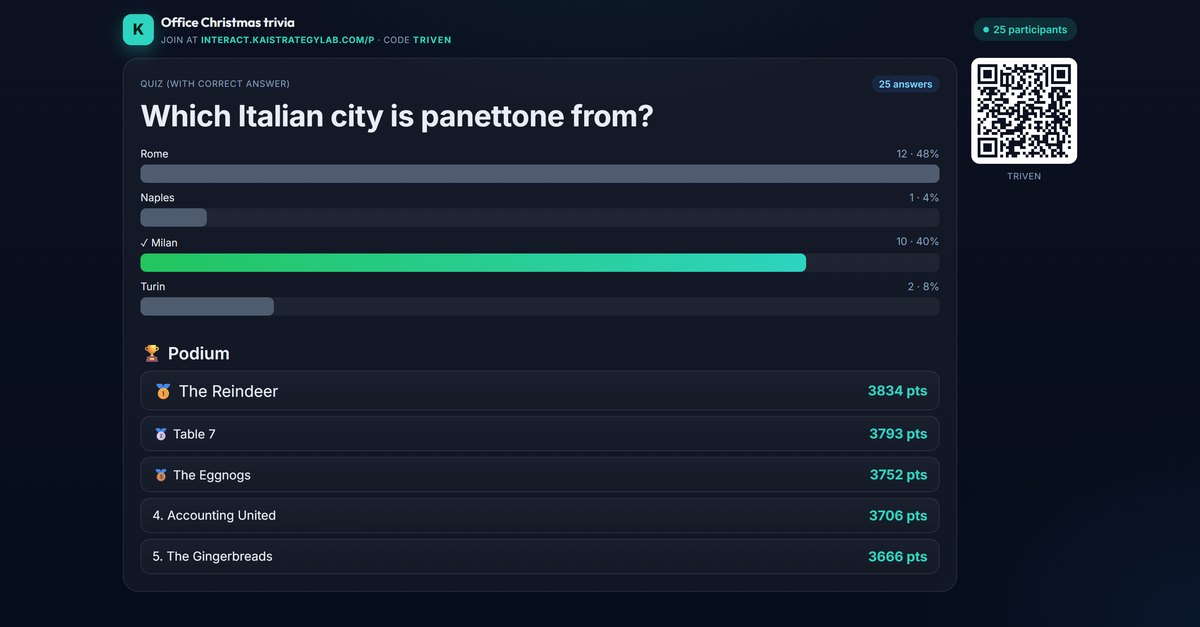
Two session settings change the game. The first is identity: choose “Name required,” so the podium shows “Table 7” or “The Reindeer” instead of an anonymous participant, and check that “Podium visible” is on (in Workshop mode it comes switched off). The second is time: give each question a twenty-second limit and a speed bonus, so that whoever gets it right quickly earns a little more than whoever gets it right at the end. The clock runs on the server and not on each person's phone, so it's the same for everyone.
The QR code stays in a corner of the screen for the whole session, and I learned that in front of three hundred and fifty people: whoever comes back late from the dessert table has to be able to join without asking you to go back to anything. The podium shows up by itself every time you reveal an answer, and you can project it full screen at the end of each round, which is when the table in third place starts asking for a rematch. If there's a tie at the top at the end, that's what the four year questions are for: turn the speed bonus up to the maximum (half the score), ask only the tied tables to answer and let the fastest correct answer win.
And the people in another city? They play just like the ones in the room. You share the screen on the video call, they scan the same QR code (or type the six-character code) and the question shows up on their own phone, without waiting for it to arrive over the video. When the question is answered from a phone, the person in the room and the person online get exactly one answer each, and nobody wins by being closer to the microphone.
About money, with no fine print. The free plan takes up to fifty people per session (thirty until you verify your email) and fifty participations a month, so a trivia for fifteen, or one for a hundred and fifty played by tables, fits in there without paying anything. If you want more than fifty phones in the same session, you have two options: a Session Pass, US$ 6.90 once, which opens that session to two hundred people without using up the month's participations, or Pro, US$ 12 a month, which goes up to five hundred per session. Either way, open the room a few minutes early and leave the QR code on the screen so people join as they arrive, and by the time you start everyone is already in.
Three office Christmas party activities for when nobody wants to compete
Not everyone wants to compete, and there are teams where a podium lands badly (they exist, and it isn't a flaw). For those there are other activities with no right answer. The first is a word cloud with a single question, “which word sums up this year for you?”: everyone writes theirs and the screen builds the cloud, with the most repeated word in the middle. The second is a thank-you wall, an open question where each person thanks someone on the team for something specific, and here I would turn on moderation, to approve each message before it reaches the screen (every party has a joker).
The third is for the argument that never fails in December, the one about the best Christmas movie. Put four or five candidates into a pairwise comparison, people answer every head-to-head matchup and the screen shows which one won the most duels, which is not the same as which one has the loudest fans. I'm not sure a word cloud can survive the same noise as a trivia game (I think it works better early on, while people are still sitting down), but I can see the movie duel surviving the second toast.
I'm left with a question I haven't figured out. Is office trivia more fun when tables compete or when everyone plays for themselves? I'd bet on the tables, but I haven't measured it. If you run it, tell me which question got your team arguing.
See you next time. Mauro Z.