Blog · Reading the room · Leer en español · Ler em português
Anonymous voting in front of the boss: the average hides the fight
In a committee, everyone agrees until they vote anonymously. Why the average hides the fight, and three things I do differently when I facilitate with executives.

In an executive committee, everybody agrees until they vote anonymously. I've seen it in rooms full of managers, on boards and in project teams, and the scene is always the same: whoever speaks first sets the tone, everyone else adds nuance around that tone, and in the end the facilitator writes “consensus” on the wall. Then the anonymous vote comes and the consensus turns out to be a seven on average, with half the room at four and the other half at ten.
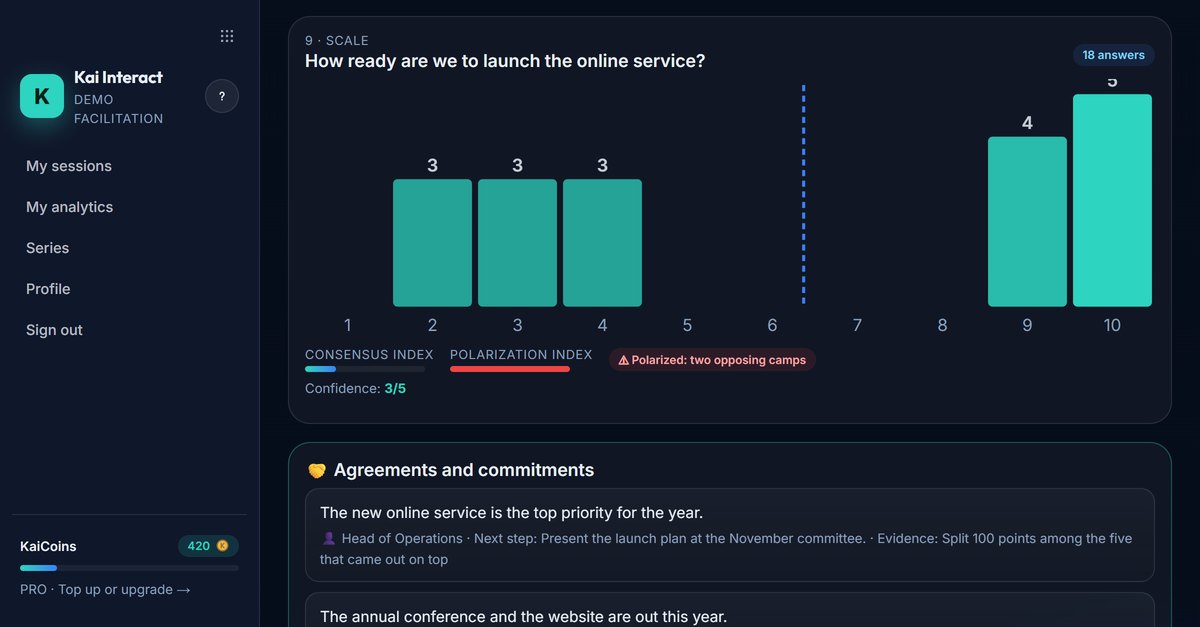
That seven is the problem this article is about. An average of seven can be twelve people who think seven, which is a calm room, or six people who think four and six who think ten, which is a room about to fight that doesn't know it yet. Both rooms produce exactly the same bar on the screen (and the same look of relief on the face of whoever called the meeting). And since the bar is what we project, it's what we decide on, and the fight happens three months later, during execution, when there's no facilitator anymore. Which of the two rooms do you have?
A friend once hit me with a line I've used ever since: “Mauro, nothing is more subjective than data.” It applies head-on here. A vote isn't objective just because it produces a number; it's as subjective as the people who voted, and that's why the first thing isn't the tool but who we seat at the table (if the people voting don't know the subject, the average is noise with decimals). But once the right people are seated, the number does tell us something the conversation hides, with one condition: that we can see the shape of the vote and not just its center.
I'll concede what needs conceding. Hierarchy exists for a reason, a committee shouldn't decide by simple majority, and there are decisions where the opinion of whoever is accountable for the outcome carries more weight, and it's fine that it does. I'm not proposing that boards vote like a town hall meeting (we have plenty of those already). I'm proposing that they vote like a thermometer: before discussing, to know where the room stands, and not after, to confirm what the first person to speak already said.
Not long ago I did something similar with a survey of many people in the same organization, and what helped me most wasn't the total but breaking it down: what the board thought, what the managers thought, what each department thought. The total said something reasonable; the parts said that the board and the managers were at opposite ends of the same question. That gap was the conversation that needed to happen, and in the total it was invisible. It took me eleven minutes to see it with the help of AI, and I don't think I'd have looked for it by hand, because you don't look for what you don't suspect.
From there come the three things I now do differently when I facilitate with executives, which I share with no guarantee that they'll work the same for you.
First, the vote comes before the discussion and it's truly anonymous, not a “raise your hand if…” vote. With phones it's trivial (a QR code on the screen, thirty seconds) and nobody has to see their neighbor's screen, which was the flaw of raised hands and of colored dots stuck on the wall while the boss watches who sticks what where. Whoever leads the meeting votes last or doesn't vote, and we announce it.
Second, we look at the spread, not the average. If half are at four and the other half at ten, that gets shown, named (“there are two rooms here”) and discussed before moving on. After the discussion we vote again, and the before-and-after comparison is the real measure of the workshop: if nothing moved, we talked for nothing; if everything moved toward the boss, we also talked for nothing, just in a different way.
Third, when the group has levels (board, managers, team), the vote gets broken down by level. Not to pit them against each other, but because the gap between levels is usually the real topic of the meeting, and it's better to see it on a chart at ten in the morning than to discover it in a hallway at five.
I used to do this halfway, with Excel and good intentions, until I built it into the tool I made. Kai Interact warns you when the group is split while the vote is still open (we call it the split-room alert, not exactly poetry), lets you re-ask after the discussion and show the before and after, and breaks down any result by a segment you asked about at the start, like department or level. I built it because I got tired of discovering the fight in the hallway, so read it with that bias.
And one doubt I still have, seriously: are there decisions where an anonymous vote does harm? I think so, when the group doesn't have the information yet and votes its prejudices. But I'm not sure where that line is. When was the last time your committee voted before talking, and what happened?
See you next time. Mauro Z.